Challenging science questions are one of the best tools I know for finding out whether students truly understand a concept or have only memorized it. In 33 years of teaching grades 6 through 12, mostly 8th grade, I learned that the questions that stretched my students’ thinking told me far more than the ones that checked their memory. Here is how I wrote them, how I used them, and what I would do differently.
What Are Challenging Science Questions?
A challenging science question is not simply a hard question or a tricky one. It asks students to apply, extrapolate, or integrate what they have learned into a scenario they haven’t seen before. In Bloom’s Taxonomy terms, it moves students beyond remembering and into applying, analyzing, evaluating, and creating.
Students who were locked in during a lesson could usually recite the facts afterward with no trouble. But reciting an answer and understanding a concept are not the same thing. The difference only showed up when I asked something relatable or gave them a task that required using what they had learned.
Why Recall Isn’t Enough
When I gave students an application question, some of them had a light bulb moment. Others were stumped and needed some prodding, questioning, and example scenarios before it sank in.
That split is exactly why challenging science questions are worth asking. A student who can define kinetic energy but can’t use the idea in a new situation doesn’t yet own it. Vocabulary is a classic trap. Students can memorize definitions and still mix up terms like population and community, which I wrote about in my post on deceptive ecosystem vocabulary. Application questions show you which students have it and which need more, and you find out before the test does.
An Example: The Energy Scenario
After we studied the forms of energy and the main ways electricity is generated, we looked at the pros and cons of each source: fossil fuels, nuclear, solar, geothermal, and wind. Then I gave students one of my favorite challenging science questions, framed as a scenario:
Imagine you live in a state that relies on electricity generated from coal. There are coal mines nearby or in neighboring states. However, prevailing winds carry the fumes from burning that coal toward your area from time to time. Your state wants cost-effective ways to reduce emissions or to find alternative ways of generating electricity. If you were in charge of researching this, which route would you take and why?
- Option A: Reduce emissions in your area
- Option B: Develop an alternative form of energy production
You can also change the scenario so that the main energy source is running low or becoming too costly.
There is no single right answer here, and that is the point. Students have to weigh cost, local conditions, available resources, and environmental impact all at once, and then defend their choice.
What to Do When Students Get Stuck
When students were stumped by challenging science questions, I didn’t hand over the answer. I asked questions that took them back through what we had covered:
- Do you remember the pros and cons of each energy source?
- What is actually available to us as a locality?
- What do you think about each of the alternatives?
- Which one would you choose, and why?
Some students just need to talk it out. Talking gave them the chance to process their thinking out loud, and many of them found their own answer halfway through the conversation. If you take one thing from this section, let it be that: build in time for talk.
A Second Example: Students as Engineers
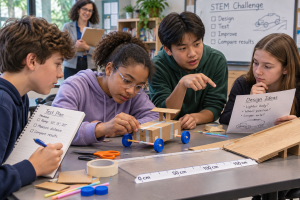
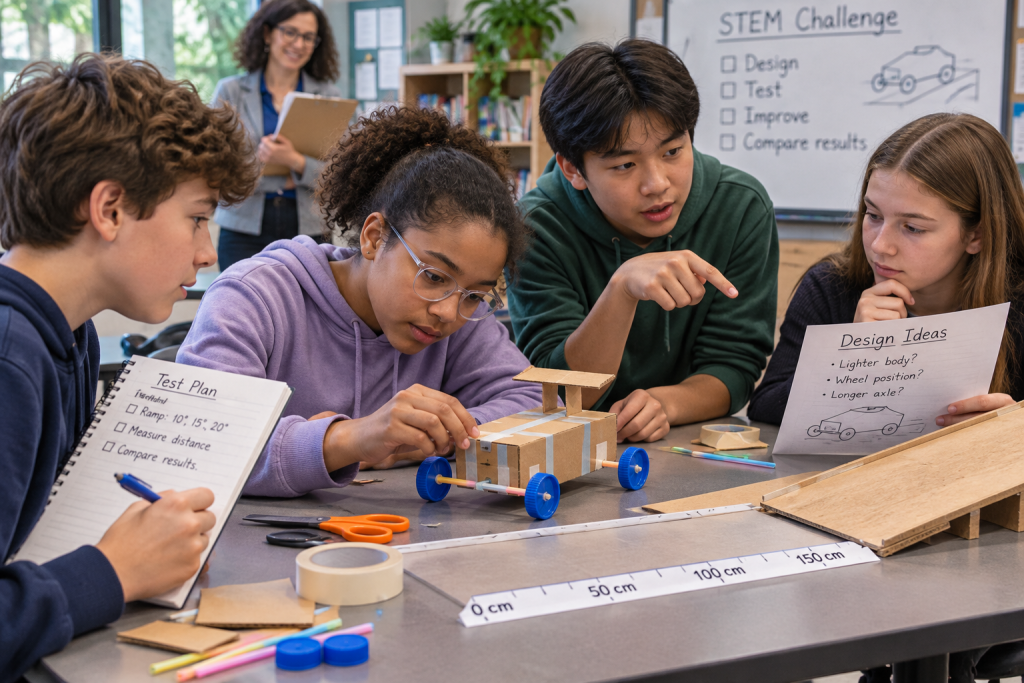
Not every challenge needs to be a written scenario. After a physics unit on force and motion, I had students act as engineers and build a vehicle to accomplish a task, such as traveling a certain distance or having features that let it do something specific. If you need to teach the content first, my Force and Energy of Motion complete lesson set covers motion, energy, force, collisions, and friction with four hands-on labs, and my free Newton’s Laws of Motion animated slide presentation is a quick way to introduce the three laws.
I posed the options, and each group chose which task to take on. Their design, though, was entirely up to them, which left plenty of room for ingenuity and problem-solving. Groups also had a limited amount of “money” to spend on parts like wheels, axles, and body structure. The budget meant they could never build the perfect vehicle. They had to prioritize, make trade-offs, and spend wisely.
On testing day, I played the role of judge and head engineer. Much like a science fair project, each team had to explain why they made the choices they did, what problems they ran into, and what they would change if they could do it again. Through my questioning, they had to show how force and motion played into their design. The defense of their work told me more than the vehicle’s performance ever could.
How to Grade Challenging Science Questions
A common worry is that open-ended questions are hard to grade. In my experience, they are easy to grade, and they show you how students think. I looked for three things:
- Did the student show an understanding of the question?
- Was their thinking suitable to the task?
- Did they take the time to explain their reasoning, ideas, and thoughts thoroughly, or did they write one or two sentences?
If a student showed good reasoning and explained their ideas, I counted it as a win, even if I would have chosen a different answer myself. A response with nothing to back it up tells you something too. It usually means the student didn’t understand what to do, didn’t seek help, took the easy way out, or showed no interest beyond turning something in. That makes the response diagnostic as well as gradable.
Where Challenging Science Questions Fit in a Unit
In my classes, these questions didn’t work well as warm-ups or exit tickets. They need more room than that. I found two spots that work best.
At the Start of a Unit
Ask the question before teaching the content, and keep the students’ answers. At the end of the unit, hand the answers back and ask: considering what you have learned, would you stick with what you said before, make a few changes, or rethink the entire process? Explain your reasoning.
This turns the question into a before-and-after record of student thinking, so students can see their own growth. It’s the same idea behind my Newton’s 3 Laws of Motion 5E bundle, where students explore and apply each law through hands-on activities and real-life scenarios before they ever see the definition.
At the End of a Unit
Used at the end, a challenging question becomes a higher Bloom’s level of processing. Students take everything they’ve learned and use it. My Human Impact on the Environment activity is one example. Students trace the minerals inside a smartphone from the mine to their pockets, then think critically about the environmental and social costs along the way.
If your schedule is packed, these questions can also work, though less effectively, on half days or the days before a break.
Why Teachers Don’t Use These Questions More Often
Here is my honest opinion. I don’t think teachers struggle to come up with challenging science questions. The real question is, “Where can I fit this into my already overloaded curriculum and schedule?”
Teachers are focused on meeting standards and pacing guides, and unless those standards leave room for higher-order thinking, it gets squeezed out. That is a system problem, not a teacher skill problem. If you want to use more of these questions, plan carefully, and look for places where the curriculum can be trimmed to make space. And if an overloaded schedule has drained the fun out of your teaching, my post on how to make teaching science exciting again may help.
My Best Advice for Writing Challenging Science Questions
If you remember only one piece of advice, make it this: don’t let the challenge get too big. Some challenges I thought would take a day or two ended up taking three or four. The kids were involved and excited, so I never cut them short, but I wouldn’t make that mistake again. Here is what I’d do instead:
- Think things out well in advance, especially if you’re on a pacing guide.
- Match the challenge to your students’ abilities. Don’t ask them to tackle a task without the knowledge or background they need.
- Find the right place in the curriculum and the right time to do it.
- Make it enjoyable.
- Give students some freedom to think, build, and act like real scientists and engineers.
I’ll add one more thing. Some students who don’t get into the usual routine come alive with challenging science questions like these. Those students alone make the planning worth it. If you have students who seem checked out, my post on how to make science engaging when students don’t care has more ideas.