It Took Me Nearly 30 Years to Discover Their Value
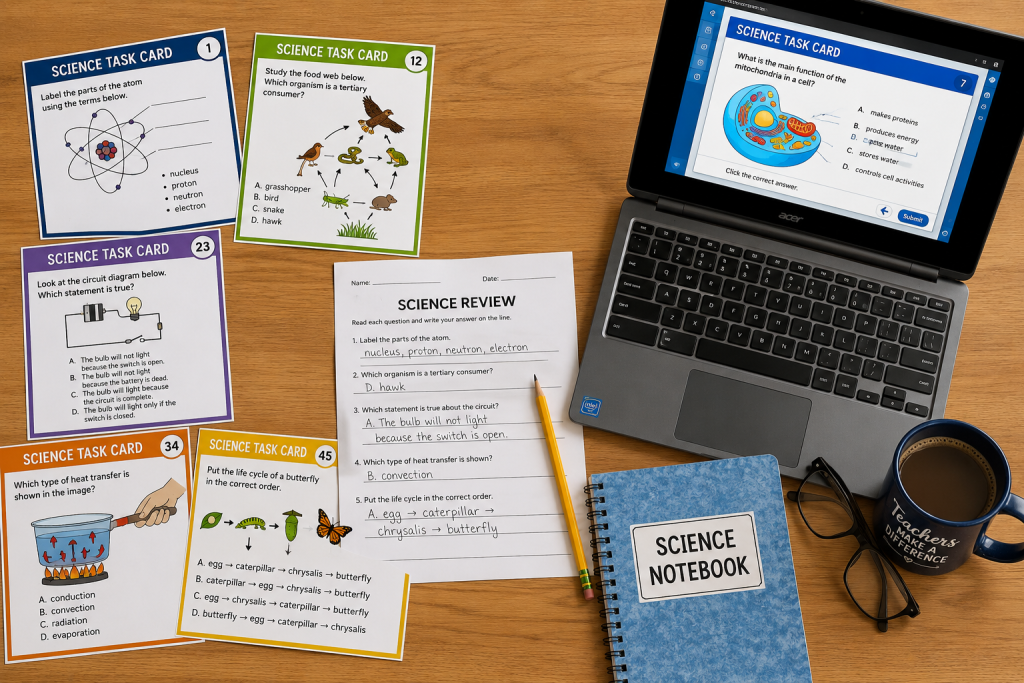
Interactive task cards didn’t become part of my middle school science classroom until nearly 30 years into my teaching career.
Not quite.
Like most teachers, I was always looking for better ways to help my students learn. Every year, I experimented with new labs, activities, and review methods. Some became classroom favorites. Others quietly disappeared after one or two attempts.
My goal wasn’t to chase educational trends. I simply wanted students to understand science, remember what they learned, and leave my classroom a little more curious than when they walked in.
One instructional strategy didn’t find its way into my classroom until much later in my career: interactive task cards.
Ironically, I wasn’t skeptical about them. I just hadn’t discovered how well they fit my teaching style.
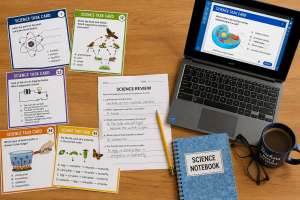
That changed when I started using digital task cards through Boom Learning.
At first, I appreciated the technology. Students could work independently and receive immediate feedback without waiting for me to grade papers. But what really caught my attention wasn’t the technology—it was my students.
Students who normally agonized through review sessions became noticeably more engaged. Instead of sitting through another slideshow while I explained concepts for the third or fourth time, they were actively answering questions, studying diagrams, and thinking through the material for themselves.
That’s when I realized something.
Students don’t learn science simply because they’ve heard a concept explained again.
They learn it because they’ve had another opportunity to interact with it.
That’s why interactive task cards earned a permanent place in my teaching toolbox.
Now, before we go any further, let me make one thing clear.
Task cards aren’t a magic solution. They won’t replace quality instruction, hands-on labs, classroom discussions, or demonstrations. No single teaching strategy can do that.
Instead, they’re another tool—one that gives students another meaningful opportunity to review, reinforce, and retain important science concepts.
And after using them with my own students, I found myself reaching for them again and again.
Not because they were the newest educational trend.
But because they worked.
Science Is a “Foreign Language”
One phrase my students heard me say throughout the year was this:
“Science is a foreign language.”
The more years I taught, the more convinced I became that it was true.
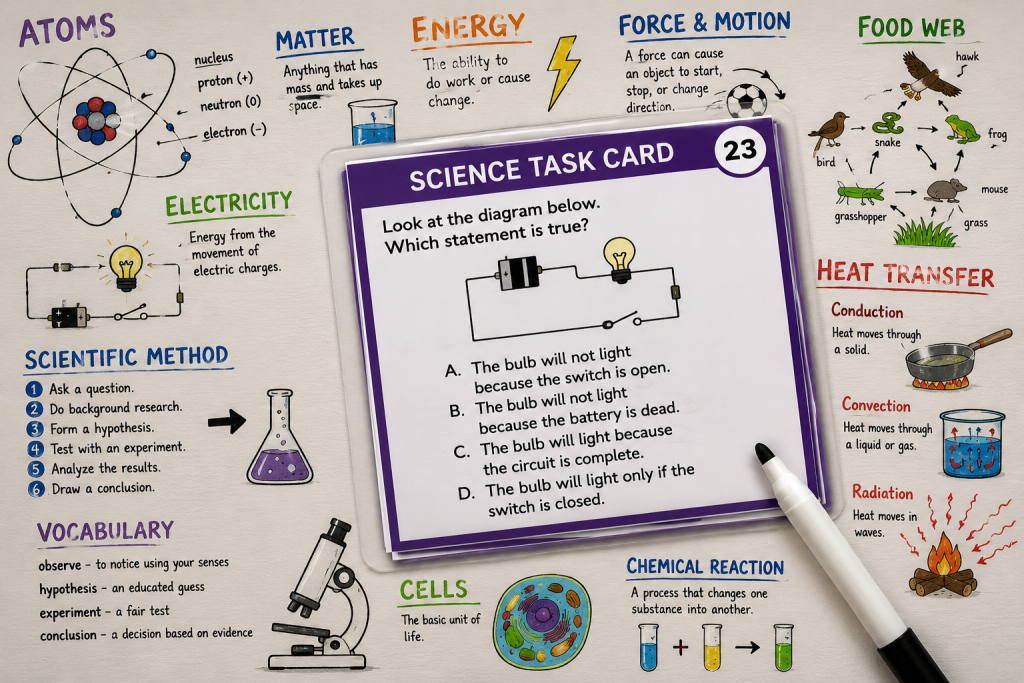
Think about everything students are expected to learn during a single school year. They’re introduced to hundreds of new vocabulary words while also trying to understand unfamiliar concepts. One month, they’re learning about atoms and the periodic table. Next, they’re studying forces and motion, ecosystems, heat transfer, electricity, or chemical reactions.
That’s a tremendous amount of information to process.
It’s also one reason many students struggle with science.
Most don’t need another lecture. They need another opportunity to work with the content.
Over the years, I learned that students remembered concepts much better when they encountered them multiple times and in different ways. A definition might introduce an idea, but answering questions, studying diagrams, interpreting models, and discussing concepts helped those ideas stick.
That’s exactly where science task cards fit into the learning process.
Rather than passively watching another review presentation, students actively engage with the material. They identify parts of an atom, distinguish between physical and chemical changes, analyze food webs, or recognize examples of heat transfer.
Every question becomes another opportunity to strengthen understanding.
Another observation shaped the way I eventually designed my own task cards.
Science is an incredibly visual subject.
Think about your own classroom. How often do you use diagrams, illustrations, models, or photographs to explain a concept? Probably every day.
A food web is easier to understand when students can see it.
The water cycle makes more sense as a diagram than as a paragraph.
Atomic structure is far clearer when students have a model to examine.
That’s why I gradually moved away from text-heavy review activities and began including more visuals in my own task cards. I wanted students to connect vocabulary with images and concepts rather than simply memorize definitions.
That small change made a big difference.
And it eventually changed the way I designed every review activity I created.
Why Interactive Task Cards Work
One misconception about interactive task cards is that they’re simply another worksheet with smaller pieces of paper.
I don’t see them that way.
What makes them effective isn’t the format.
It’s the interaction.
Students are reading, thinking, comparing, recalling, and making connections instead of simply listening to the teacher review material from the front of the room.
That shift from passive learning to active learning is important.
Digital task cards add another advantage by providing immediate feedback. Students don’t have to wait until the next day to discover whether they understood a concept correctly. They can learn from mistakes while the lesson is still fresh in their minds.
Whether you use paper or digital versions, the purpose is the same.
They’re another opportunity for students to revisit important concepts.
That’s exactly what a science student, or any student, needs.
The more meaningful interactions students have with a concept, the more likely they are to remember it.
More Than Just Vocabulary Practice
When I first created interactive task cards, I made a mistake that many science teachers probably make.
I focused on vocabulary.
To be fair, vocabulary is incredibly important. I’ve always believed that science is a language all its own. If students don’t understand terms like conduction, photosynthesis, or density, they’re going to have a difficult time understanding the concepts those words describe.
But after using task cards for a while, I realized something.
Vocabulary is only the beginning.
A student may know that conduction is the transfer of heat through direct contact. That’s great. But can that same student identify conduction in a picture of a metal spoon sitting in a pot of hot soup? Can they explain why the handle gets hot? Can they distinguish conduction from convection in another example?
That’s where real understanding begins.
The same idea applies throughout science. Students shouldn’t just memorize that producers make their own food. They should be able to identify producers in a food web. They shouldn’t simply define a chemical change—they should recognize one when they see it.
That realization also influenced the way I approached many of my review activities—not just my interactive task cards.
Over the years, I found myself relying less on simple vocabulary drills and more on activities that required students to think about the concepts behind the words. Depending on the lesson, that might include interpreting diagrams, analyzing images, matching related ideas, sequencing scientific processes, identifying misconceptions, or comparing examples and non-examples.
When I created interactive task cards, I tried to bring that same philosophy with me. Vocabulary was still an important part of the activity, but whenever it made sense, I included questions that encouraged students to think beyond memorization.
The result was a richer review experience.
Students weren’t simply recalling information—they were making connections.
Today, vocabulary remains an important part of my science task cards because it’s the foundation of scientific understanding. But I’ve learned that students benefit even more when they can connect those words to diagrams, models, and real-world examples.
The Biggest Benefits I Saw in My Classroom
Every teacher eventually asks the same question about a new instructional strategy:
Is it worth the time?
After using interactive task cards with my eighth-grade science students, my answer became an easy “yes.”
Not because they solved every classroom challenge.
But because they always made my review lessons better.
Students Were More Engaged
The first thing I noticed was increased engagement.
My initial review sessions often relied on slide presentations. I’d ask a question, maybe discuss the answer, and move on to the next slide. Some students participated. Others simply waited for the review to end.
Task cards changed that.
Instead of watching me review science concepts, students became active participants. They were reading, thinking, answering questions, and discussing ideas with classmates. Even students who weren’t usually eager to participate became more involved because they had something meaningful to do.
That shift from passive listening to active learning made a noticeable difference.
Students Retained More Information
One thing thirty years of teaching taught me is that students rarely remember a concept after hearing it once.
They remember it after encountering it several times.
That’s why I believe review is so important.
Every time students revisit vocabulary, interpret a diagram, or answer a question correctly, they’re strengthening another connection in their memory.
Did every student suddenly remember every concept?
Of course not.
There will always be students who resist learning regardless of the activity.
But for many students, these repeated interactions helped improve retention, and that’s exactly what I wanted from a review activity.
Classroom Management Improved
Middle school students aren’t known for wanting to sit quietly through lengthy reviews.
When students are actively engaged, however, classroom management often takes care of itself.
Whether students were completing digital task cards independently or working through paper cards with a partner, they stayed focused because they had a purpose.
There was less downtime.
Less waiting.
And fewer opportunities to become distracted.
No instructional strategy eliminates classroom management issues completely, but I found that engaged students were generally productive students.
Students Built Confidence
Another benefit I appreciated was the confidence many students developed.
Not everyone learns at the same pace.
Some students moved quickly through a review deck.
Others needed more time to think through each question.
Interactive task cards allowed both groups to be successful.
Students who struggled weren’t pressured to keep up with everyone else, while stronger students could continue working without waiting for the rest of the class.
That flexibility helped many students experience success, and success often leads to greater confidence.
They Became One of My Favorite Test Review Tools
Perhaps the greatest value I found in task cards came at the end of the school year.
Here in Virginia, eighth-grade students take a cumulative science assessment covering three years of science instruction.
That’s a lot of content!
Reviewing everything through lectures or slide presentations simply wasn’t practical.
Task cards allowed students to revisit dozens of important concepts in a relatively short amount of time while staying actively engaged.
Some students worked independently.
Others worked on questions with a partner.
Either way, they were interacting with the science instead of simply listening to me explain it again.
For many students, that extra review made a real difference.
Paper Task Cards vs. Digital Task Cards
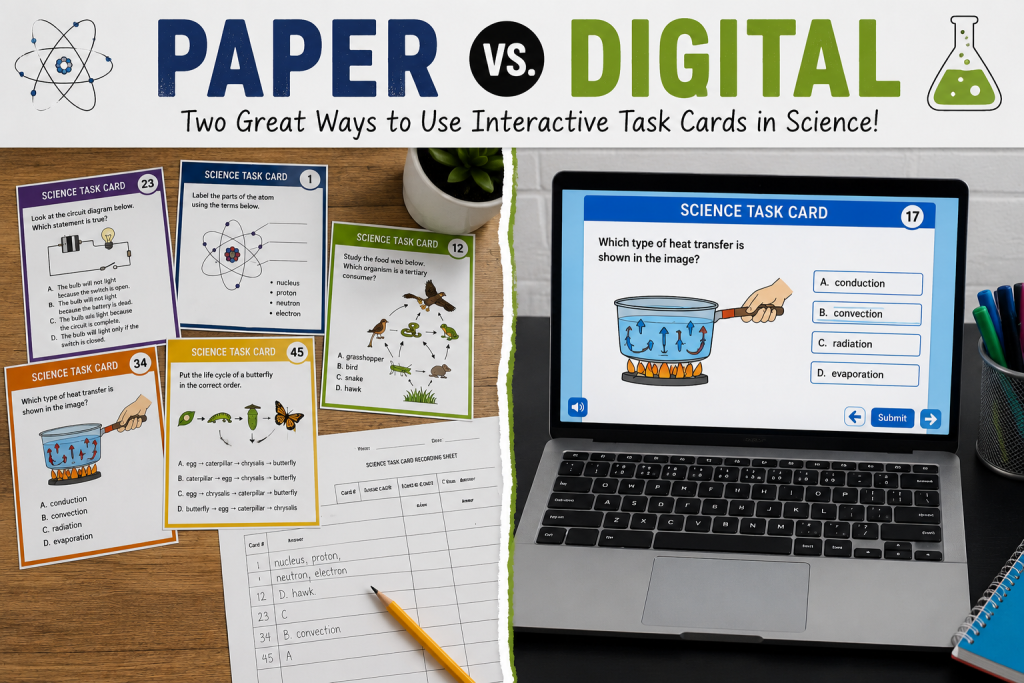
Are paper or digital task cards better?
Honestly, I don’t think there’s a wrong answer.
I’ve used both, and each has strengths.
Paper Task Cards
Paper task cards are excellent when you want students to move around the classroom.
Learning stations.
Gallery walks.
Partner activities.
Small-group discussions.
Middle school students enjoy getting out of their seats, and task card stations allow them to move while staying focused on science.
Of course, paper cards also require more preparation.
Printing.
Cutting.
Laminating.
Organizing.
And if you’re making double-sided cards…
Trying to convince your printer to cooperate.
If you’ve ever spent twenty minutes trying to get front-and-back printing to line up correctly, you know exactly what I’m talking about.
Digital Task Cards
Digital task cards solve many of those preparation headaches.
There’s nothing to print or laminate, and students receive immediate feedback as they work.
That instant feedback became one of my favorite features because students didn’t have to wait until the next day to find out whether they understood a concept correctly.
Updating digital decks is also simple. If I wanted to improve a question or replace an image, I could make the change in just a few minutes.
Which Do I Prefer?
The answer depends on the lesson.
If I wanted movement and collaboration, paper task cards worked beautifully.
If I wanted students working independently with immediate feedback, digital task cards would be my first choice.
Fortunately, teachers don’t have to choose one or the other.
Having both available simply provides more flexibility throughout the school year.
My Favorite Ways to Use Interactive Task Cards
One of the biggest surprises for me was how often I found myself using task cards.
Initially, I created them primarily for review.
Before long, I was pulling them out in all kinds of situations.
Some of my favorite uses included:
- Bell ringers to review the previous day’s lesson.
- Test review before quizzes and unit assessments.
- Early finisher activities that kept students engaged with meaningful science content.
- Independent practice for students needing additional reinforcement.
- Substitute lesson plans that required very little explanation.
- Emergency lesson plans for those unexpected schedule changes every teacher eventually experiences.
Once you’ve created a quality set of interactive task cards, you’ll probably find yourself using them much more often than you expected.
They’re flexible, easy to adapt, and useful throughout the school year.
In the final section, I’ll share a few lessons I learned while creating task cards, some common misconceptions about them, and a few suggestions for teachers who are just getting started.
Lessons I Learned Along the Way
Every instructional strategy teaches the teacher something.
Interactive task cards were no exception.
Looking back, there are a few things I wish I had done differently from the very beginning.
Don’t Make Everything About Vocabulary
As I mentioned earlier, my first task cards were almost entirely vocabulary-based.
That wasn’t necessarily a bad decision because vocabulary is critical in science. Students can’t explain concepts they don’t have the language to describe.
But over time, I realized vocabulary should be the starting point—not the finish line.
Students need opportunities to use scientific terms in context. They need to analyze diagrams, compare examples, recognize misconceptions, and connect ideas.
Those kinds of questions develop understanding far better than memorizing definitions alone.
Today, whenever I create a new set of science task cards, I make sure there’s a healthy mix of vocabulary and concept-based questions.
Keep the Wording Simple
A lesson I learned fairly quickly was that wording matters.
If students have to spend time figuring out what a question is asking, they’re spending less time thinking about the science.
I’ve always tried to write questions that are straightforward, objective-focused, and easy to understand. That doesn’t mean the science is easy—it simply means students aren’t distracted by confusing wording.
Before using a new task card activity, I usually read every question again and ask myself, “Would my eighth graders misunderstand this?”
If the answer is yes, it needs a rewrite.
Use More Visuals
If I could go back and improve my earliest task cards, this is probably the biggest change I’d make.
I’d use more visuals.
Science is naturally visual. Students spend much of the school year interpreting diagrams, models, graphs, photographs, and illustrations.
Why should review activities be any different?
Including more images in task cards helps students make connections more quickly.
Instead of defining a food web, they analyzed one.
Instead of describing an atom, they identified its parts.
Instead of memorizing heat transfer vocabulary, they interpreted illustrations showing conduction, convection, and radiation.
For many students, seeing the science made understanding the science much easier.
The Printer Wasn’t Always My Friend
I’ll admit this one with a forced smile.
Creating paper task cards takes patience.
Designing them was the fun part.
Getting them to print correctly…
Not always so much.
If you’ve ever tried printing double-sided cards only to discover the backs are upside down or slightly misaligned, you’ve experienced that frustration.
Thankfully, digital task cards eliminated those problems.
Still, I wouldn’t let printing challenges keep you from creating paper task cards. Once they’re finished, you’ll likely use them for years.
Common Myths About Interactive Task Cards
Like many classroom strategies, task cards have developed a few misconceptions over the years.
Let’s look at four of the most common.
Myth #1: They’re Only for Review
Review may be their most common use, but it’s certainly not their only one.
I’ve used task cards as bell ringers, reinforcement activities, independent practice, small-group discussions, substitute lessons, and early finisher activities.
They may be more versatile than many teachers realize.
Myth #2: They’re Just Busy Work
They certainly can be.
But so can worksheets, labs, projects, or any other classroom activity if they aren’t designed well.
Quality task cards should have a clear learning objective. Every question should reinforce an important science concept or skill.
When they’re thoughtfully designed, students aren’t simply staying busy.
They’re learning.
Myth #3: They’re Only for Elementary Students
Not at all.
I’ve used them successfully with middle school students, and the same instructional strategy can easily be adapted for high school or even college-level courses.
The format stays the same.
Only the content changes.
Myth #4: They Take Too Much Time to Create
I’ll agree with this one to a degree.
Creating quality task cards does require time.
You have to think through the objectives, write good questions, choose appropriate visuals, and proofread everything before using them.
But here’s the payoff.
Once you’ve created a solid deck, you can use it year after year.
You can update it.
Modify it.
Differentiate it.
Convert it from paper to digital if you choose.
That initial investment continues paying dividends long after the first year.
Tips for Teachers Just Getting Started
If you’re thinking about adding interactive task cards to your classroom, my advice is simple.
Start small.
You don’t need fifty task cards covering every science unit before you begin.
Create one or two decks each grading period.
Focus on quality rather than quantity.
About ten well-designed cards are enough to create an effective review activity for most lessons.
As you create your cards, keep your learning objectives in mind. Every question should support what you want students to know or be able to do.
Whenever possible, include diagrams, illustrations, or photographs. Science is visual by nature, and your review activities should reflect that.
Finally, don’t expect perfection the first time.
Use the cards.
Observe your students.
Take notes.
Then make improvements before using them again next year.
Teaching has always been a process of refining what works, and task cards are no different.
Why Visuals Matter So Much
If you’ve used many of my science resources, you’ve probably noticed that I rely heavily on visuals.
That’s intentional.
For more than ten years, I had students complete learning style inventories to help them better understand how they learned best. While every classroom included a variety of learning preferences, I consistently found that many middle school students benefited from seeing science rather than simply reading about it.
That observation changed the way I taught.
Instead of relying solely on text, I looked for opportunities to include diagrams, illustrations, photographs, and models throughout my lessons.
The same philosophy carried over into my task cards.
A picture of an electrical circuit often explains more than several sentences.
A labeled atom helps students make sense of atomic structure.
A food web immediately illustrates relationships that are difficult to describe with words alone.
Visuals don’t replace good instruction.
They reinforce it.
And when students connect words with images, they’re much more likely to remember both.
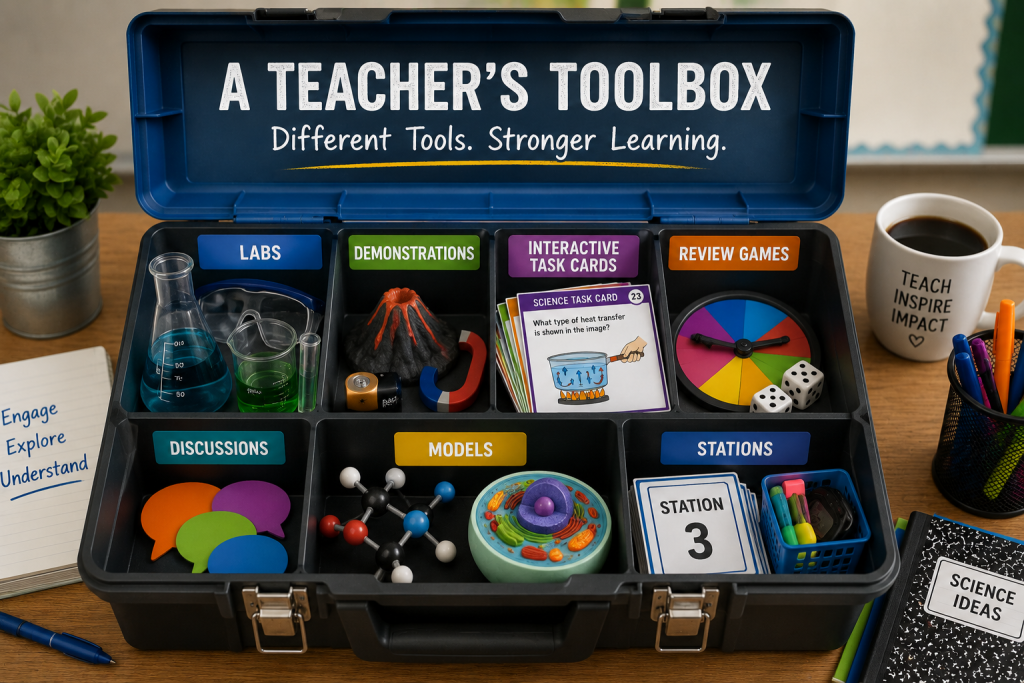
Interactive Task Cards Belong in Every Science Teacher’s Toolbox
After nearly thirty years in the classroom, one thing became very clear.
There is no perfect teaching strategy.
Every experienced teacher builds a toolbox filled with methods that work in different situations.
Some days call for a hands-on lab.
Other days require direct instruction.
Sometimes students need a demonstration.
Sometimes they need a classroom discussion.
And sometimes…
They need another opportunity to engage with key scientific concepts.
That’s exactly where interactive task cards fit.
They’re flexible enough to use throughout the school year.
They’re easy to adapt for different learners.
They encourage students to become active participants instead of passive listeners.
Most importantly, they provide another opportunity for students to strengthen their understanding of science.
Looking back, I only wish I had discovered them earlier in my teaching career.
Would they have replaced every other review strategy I used?
Of course not.
But they would have become another dependable tool I reached for time and time again.
If interactive task cards aren’t already part of your teaching toolbox, consider giving them a try.
Start with a single deck.
See how your students respond.
Refine it as you go.
You may discover what I did—that one more opportunity to interact with science can make a meaningful difference in what students remember long after the lesson is over.