
I recently came across a post from an experienced middle school science teacher who enjoyed her school but no longer enjoyed teaching science as much as she once had. After ten years in the classroom and several years teaching the same and different grade levels, she felt stuck in a rut. Changing grade levels was not really an option, so she asked other science teachers what they did to bring some excitement back into their teaching.
I suspect many experienced teachers have felt exactly the same way.
You can work at a good school, appreciate your coworkers, care deeply about your students, and still feel as though some of the excitement has drained out of teaching. That does not mean you are a bad teacher. It does not necessarily mean you need to change schools, change grade levels, or begin filling out retirement paperwork during your planning period.
Sometimes the problem is that your routine for teaching science has become too predictable—for your students and for you.
I know because it happened to me.
Recognize the Wash-Rinse-Repeat Teaching Science Rut
In the beginning, my teaching followed a fairly typical pattern.
I taught the material. Students wrote notes. We reviewed the information. We might complete an activity or lab. Then I gave a test, moved to the next topic, and started the process again.
Teach. Notes. Review. Activity or Lab. Test.
Wash. Rinse. Repeat.
My approach to teaching science had become efficient, familiar, and far too predictable.
There was nothing inherently wrong with that structure. Direct instruction, notes, review, and assessment all have a legitimate place in the science classroom.
The warning sign was the lack of enthusiasm I felt while teaching.
I also began noticing the expressions on my students’ faces. They had that unmistakable look that said, “Oh no. Not another wash-rinse-repeat lesson.”
Middle school students may not always tell you what they are thinking, but their faces frequently surrender a full written report.
The lessons were getting the job done, kind of. But something was missing. My students were becoming passive or rebellious participants, and I felt responsible for supplying nearly all the energy in the room.
That arrangement was not particularly exciting for them, and it was becoming even less exciting for me.
Stop Searching for the One Perfect Teaching Method
When teachers begin looking for ways to make teaching science more exciting, it is tempting to search for one big solution.
Maybe a new curriculum will fix it.
Maybe more technology will fix it.
Maybe every unit needs a project, competition, elaborate lab, escape room, dramatic demonstration, and background music worthy of a superhero movie.
New resources and strategies can help. However, there is no single teaching method that will permanently solve disengagement.
There is no one-way-fits-all approach in teaching.
A strategy may work beautifully with one class and fall completely flat with another. It may energize a particular unit but make little sense in the next one. It may produce excellent results for several years and then slowly become another routine.
That is one of the biggest lessons I learned over my years in the science classroom.
Instead of searching for the perfect method, I began treating my classroom more like a laboratory.
I tried an idea.
I watched what happened.
I adjusted the variables.
I kept what worked, changed what almost worked, and moved away from what no longer served its purpose.
That experimental mindset helped me make teaching science more exciting without trying to reinvent my entire course overnight.
Experiment With a More Student-Centered Approach
One approach that helped me was Layered Curriculum.
This more student-centered approach to teaching science gave students greater ownership without removing the structure they needed.
However, I need to be clear: I did not simply adopt the program exactly as designed and declare it the answer to every instructional problem.
I modified it to suit my teaching situation.
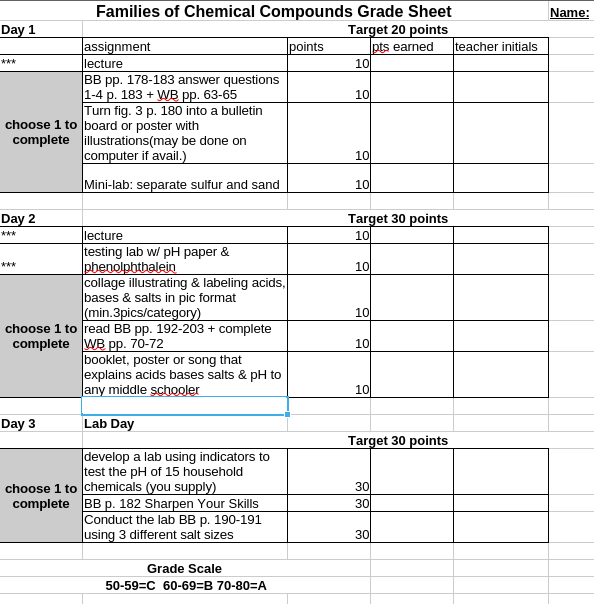
My version had to work with my students, my schedule, my standards, my curriculum, my available materials, and the way I taught science. The grade sheets* I created reflected my adaptation of the approach, not necessarily every feature of the formal Layered Curriculum model.
I also started small.
I tested the waters with one or two lessons rather than converting my entire course at once. That was important because changing every unit simultaneously would have created an enormous amount of work and probably a new type of teaching misery.
My adapted grade sheets included both required work and choice work. Students earned points for completing work each day, but they had multiple ways to learn and show what they understood.
The structure provided boundaries. The choices provided variety.
And that combination began changing the classroom.
I did not wait for perfect conditions
I did not present a twelve-page proposal to my principal or assemble a special science department committee to study the matter for six months.
I tried it.
Yes, it was a bit of a gamble. But it was a small, controlled gamble. I began with only a few lessons and kept everything tied to the required standards and objectives.
That is the advantage of starting small. You can experiment without putting an entire quarter’s instruction into an academic blender and hoping something drinkable comes out.
Give Students Different Ways to Show Learning
I began to see that teaching science did not require every student to demonstrate understanding in the same way.
The biggest change was giving students more choice in how they demonstrated what they had learned.
Depending on the lesson or unit, students might:
- Watch a video and answer questions
- Complete questions from a book
- Build a model
- Perform a skit
- Create artwork or a mini-poster
- Develop a presentation
- Complete a mini-lab
- Design an investigation
- Use another approved method to demonstrate understanding
This did not mean students could simply do whatever they wanted.
There was still required work. There were still standards, deadlines, expectations, and points to earn. Choice existed inside a structure.
That distinction matters.
Student-centered science activities do not require the teacher to surrender all control, point toward a cabinet of supplies, and announce, “Go discover science.”
Middle school students need freedom, but they also need guardrails. Occasionally, they need fences reinforced with concrete barriers and flashing lights.
The goal was to give students meaningful choices while keeping the learning focused on the science content.
Watch Student Engagement Begin to Change
The students did not immediately cheer and declare my new approach the greatest educational development since the invention of the three-ring binder.
At first, many of them did not know what was going on.
They were accustomed to the traditional pattern they had experienced in previous science classes. The teacher explained. Students wrote. Everyone completed the same assignment. The class moved forward together.
Now they were being asked to make choices and take more responsibility for their work.
That required an adjustment.
Over time, however, they loosened up and began understanding how the classroom operated. They became more comfortable making decisions and showing what they had learned in different ways.
Their engagement changed noticeably.
Students became more invested
Students began putting more enthusiasm into their work. Some of the models, presentations, artwork, investigations, and other products they created went above and beyond what I had envisioned.
I had hoped the approach would produce a turnaround, but I was still pleasantly surprised by what some students accomplished when they were given room to work using their own strengths and interests.
In a few cases, students asked whether they could remain through the next class so they could finish what they were working on.
Middle school students voluntarily asking for extra time to complete science work is not quite the same as observing a new species in the wild, but it certainly gets a teacher’s attention.
Discipline problems decreased
The change also helped reduce discipline problems.
They were not eliminated. Let us not wander into fantasy.
However, the problems were whittled down.
Students who were actively building, designing, creating, investigating, or preparing something had less time and less reason to search for alternative entertainment.
Greater ownership did not magically solve every behavioral problem, but it changed the atmosphere of the classroom.
Shift From Lecturer to Science Coach
The new approach not only affected student engagement, but it also changed my own experience as a teacher. And that helped make teaching science more exciting again.
I loved moving around the room from student to student and group to group.
I could make positive comments, offer suggestions, ask questions that pushed students to think, congratulate progress, and help students work through problems.
I felt less like someone delivering the same performance several times a day and more like a real teacher…a science coach.
Instead of asking only, “Did you finish the assignment?” I could ask questions such as:
Questions that encouraged scientific thinking
- Why did you choose that design, idea, or method?
- What evidence supports your explanation?
- Which variable did you change?
- What happened when you tested it?
- Why do you think your results differed from another group’s?
- What would you change if you tried it again?
- How does your choice demonstrate today’s science concept?
Those kinds of conversations were more eye-opening for the students, and they were more interesting for me.
When students are all completing the same worksheet at the same time, the teacher already knows what most of the finished products will look like.
When students are making choices, developing designs, and explaining their reasoning, the teacher has more opportunities to observe genuine thinking.
That helped make teaching science more exciting again.
Use Labs and Challenges to Add Variety
Labs were my bread and butter.
Hands-on investigations had always been one of my favorite parts of teaching science, but adding challenges gave them even more purpose.
I loved giving students opportunities to investigate science directly. I also wove challenges into lessons whenever they fit the topic.
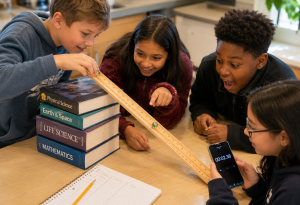
One example was a marble-ramp activity connected to our study of motion, speed, velocity, and acceleration. Students worked with the materials, tested ideas, collected information, and made adjustments.
Another favorite involved catapults during our study of forces.
Students designed and built catapults. When the work was complete, groups had a standoff in which they fired marshmallows at their opponents’ castles.
Science standards were addressed.
Forces were demonstrated.
Marshmallows achieved flight.
A good day was had by many.
At other times, I gave students a problem, placed them into groups, pointed toward the available equipment, and said something along the lines of:
“There’s the equipment. Don’t forget to design before you build.”
Then I let them get started.
Add guardrails when necessary
Of course, I learned that students sometimes needed more structure before receiving the supplies.
Eventually, the procedure became something closer to this:
- Develop a design.
- Explain the reasoning behind it.
- Show the plan to the group members.
- Show the plan to me.
- Receive the supplies.
- Begin building and testing.
That modification is a good example of how teaching strategies evolve.
The first version does not have to be perfect. Try it, watch what happens, and add the necessary roadblocks before someone uses half your supply cabinet to construct something only loosely connected to the assignment.
Be Honest About the Downsides
Student-centered science activities produced good results, but the approach was not perfect.
One major downside was grading.
I graded the choice activities each day and wrote a large number of comments, both positive and corrective. That feedback was valuable, but it required time.
I often did not reach the parking lot until 5:00 or 5:30 in the afternoon.
That is not a minor detail.
It is easy to promote an instructional method by discussing the engagement and creativity while quietly ignoring the extra planning, grading, organizing, and monitoring required.
Teachers deserve the full picture.
Some students chose the easiest option
A few students selected the activity they believed would require the least effort.
Sometimes the supposedly easy choice worked out for them. More often than not, the lack of effort did not earn many points on the grade sheet.
They did not always appreciate that outcome.
However, the points and my written comments made the reason clear. Having a choice did not mean receiving full credit for minimal work.
Copying became another issue
Students sitting near each other sometimes chose the same activity, and the finished products occasionally looked remarkably similar.
At times, I split the points between them. More often, I asked one student to choose something else to complete.
That sometimes led to the inevitable protest:
“I did the real work. Johnny just copied what I did.”
Teachers have been investigating that claim since the invention of the slate tablet.
The larger point is that student choice still requires teacher oversight, individual accountability, and clear expectations.
Remember That Even a Good Strategy Can Become Routine
The grade sheets created a large amount of variety and produced good results.
But even they could eventually begin to feel like the same old, same old.
That is important.
A student-centered system can become predictable just as lectures, worksheets, and traditional assignments can. When students repeatedly encounter the same structure, even a flexible structure, the novelty and energy may begin to fade.
The same is true of nearly every instructional tool:
- Worksheets
- Videos
- Computer simulations
- Labs
- Games
- Projects
- Technology
- Choice boards
- Interactive notebooks
- Grade sheets
- Group challenges
- Kahoot
Any of them can be valuable.
Any of them can also be overused.
The answer is not constantly chasing novelty or trying to make each lesson more spectacular than the one before it. That is exhausting and unsustainable.
The answer is to pay attention.
Watch the students.
Watch the classroom energy.
Watch your own enthusiasm.
When a useful strategy begins losing its freshness, adjust it. Change the format, reduce how often you use it, combine it with something else, or set it aside for a while.
A successful strategy should remain a tool. It should not quietly become the next rut.
Do Not Confuse Variety With Constant Entertainment
Teachers who want to make teaching science more exciting do not need to turn every class period into an entertainment show.
Every lesson does not require a competition, an explosion, a dramatic demonstration, a lab, or airborne marshmallows.
Students still need to:
- Listen to explanations
- Take notes
- Read scientific information
- Learn vocabulary
- Analyze data
- Practice skills
- Write explanations
- Review concepts
- Complete assessments
Direct instruction is not the enemy.
Worksheets are not automatically bad.
Videos are not automatically engaging.
Labs are not automatically effective.
Technology is not automatically innovative.
The problem is usually not the method itself. The problem is using the same method over and over until students and the teacher can predict every step before class begins.
Middle school students benefit from variety, but variety does not mean pandemonium or nonstop novelty.
It means using different approaches for different purposes; variety in teaching science does not mean replacing one overused method with another.
Start With One Lesson
A teacher who is already in a rut does not need advice that creates another overwhelming task.
“Redesign your entire curriculum” is not encouragement. It is a threat.
Start with one unit, one topic, or even one lesson.
Choose something that feels especially stale.
Then ask:
Questions to guide your experiment
- Could students make one meaningful choice?
- Could they build or design something?
- Could they select how to demonstrate understanding?
- Could they investigate before receiving the full explanation?
- Could they compare different models or solutions?
- Could they solve a real-world problem?
- Could they revise their work after receiving feedback?
Try the change and observe what happens.
Pay attention to the students’ response, but also pay attention to your own.
Did you enjoy teaching the lesson more?
Were the conversations more interesting?
Did students show greater ownership?
What created problems?
What would you modify the next time?
Then choose another lesson and experiment again.
By the end of the year, you may have a collection of student-centered science activities without having spent an entire summer trying to transform every unit at once.
Collaboration can also help. One teacher can design an activity for one topic while another teacher develops something for a different topic. Share the results, and both teachers gain more variety without doubling their workload.
Keep Changing the Variables
So, how do you make teaching science more exciting when you feel stuck in a rut?
There is no single answer.
Layered Curriculum helped me, but I modified it. My grade sheets provided structure, variety, student choice, and good results. Labs and challenges helped. Giving students different ways to show learning helped. Becoming more of a science coach helped.
But none of those strategies was a permanent cure.
Teaching science became more enjoyable when I stopped searching for the one perfect method and started treating my classroom more like a laboratory.
I tried ideas.
I watched what happened.
I adjusted the variables.
I kept what worked, modified what almost worked, and changed the approach when it began to grow stale.
You may not need to switch grade levels or find a new school.
You may need to choose one tired lesson, change one variable, and see what happens.
*One of many variations on a “gradesheet”.