If your child says, “I don’t get science,” it’s easy to assume they’re not a “science kid.” After 30+ years teaching grades 6 through 12, mostly 8th grade, I can tell you that is rarely the real problem. Most of the time, a child struggling with science is missing something that’s fixable.
I’m Eric, the science teacher behind Its Science, and in this post I’ll share what I learned about why a child struggling with science gets stuck and what parents can do about it..
The Most Common Reason: Science Is a Foreign Language
The number one struggle I saw was vocabulary. If you don’t understand the words used in science, it’s very hard to understand the concepts. On the first day of school, I told my students that science is a foreign language, and that my job was to help them understand both the wording and the concepts.
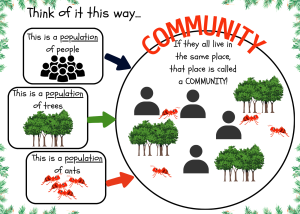
Many science words sound familiar but mean something very specific. Words like force, work, energy, theory, and community are used every day, but in science each one has a precise meaning. A child who doesn’t know that is trying to follow a lesson in a language they haven’t learned yet. If you want to see how tricky this can get, I wrote about one example in Populations versus Communities: Deceptive Ecosystem Vocabulary.
What a Child Struggling With Science Looks Like

Over the years, I learned to spot a child struggling with science without a single word being said. The blank stare. The befuddled look. The deer-in-the-headlights freeze. When I saw those, I knew a student wasn’t getting it.
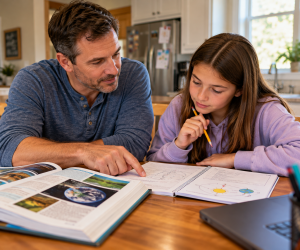
Those looks aren’t laziness or a bad attitude. The child is lost, and they often don’t know how to say so out loud. If you see that look at the kitchen table during homework, treat it the same way: your child is probably stuck on the language or on one missing piece, not unwilling to try.
How I Helped Students Get Unstuck
When I noticed that look, I would work with the student one-on-one while the rest of the class worked. If they still didn’t get it, I would have a classmate help them. Once we got past that mental block, their thinking opened up, and they got it. Some were slower than others, but they all got there.
Why Relating Science to Real Life Works
The key to my teaching was making concepts relatable to students’ everyday lives. For motion and forces, I always used sports. Students who couldn’t picture Newton’s Laws on paper could suddenly explain them when we talked about the arc of a basketball shot, a baseball pitch, or a volleyball serve.
Not every child plays the big sports, so I also used skateboarding, skiing, dance, wrestling, golf, martial arts, and horseback riding. We even watched billiards videos and talked about the physics. When a child already understands something from their own world, you can build the science on top of it. You can read more in my post, Sports-Inspired Strategies for Teaching Science.
If your child is working on forces and motion at school, my Forces & Motion: A Visual Science Workbook builds on this same idea of making the concepts clear and relatable.
What You Can Do at Home Tonight
You don’t need a science background to help a child struggling with science. Here is where I would start:
- Begin small. Don’t try to fix the whole unit at once. Pick one idea or one vocabulary word and make sure it makes sense.
- Begin at the beginning. If your child is lost, the confusion usually started earlier than you think. Go back to the foundation and build up from there.
- Learn alongside your child. Tell them, “Let’s figure this out together.” This builds confidence and familiarity, and it shows your child that not knowing something is just the starting point.
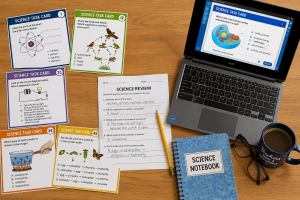
- Give them a clear, visual resource. A workbook that explains concepts step by step helps fill gaps without the pressure of a classroom. My Visual Science Workbook Series was designed for grades 5 through 8 to do exactly that.
- Talk to the teacher. Write down your questions and ask them the next day, or schedule a time to talk before school, after school, or during the teacher’s planning period.
Why So Many Kids Walk Into Science Already Resistant
Here is my honest opinion from my years in the classroom. Science has never received the same outside support as math and English. Those subjects get in-school support (such as language or math resource experts), homogeneous grouping, extra practice, and attention at home. Science often gets very little.
Sadly, many students come into science with a negative and resistant mindset. In my experience, it usually came down to one of these:
- The “my mom (or dad) was never good at science” excuse
- Previous science teachers who didn’t use enough hands-on activities, which I believe are the basis of good science
- Bad experiences or bad grades that stuck with them
- School systems that didn’t back science in the elementary and middle grades
A Strong Science Foundation Starts in Elementary School
In my opinion, a strong science background begins in elementary school. If we wait until middle school to take science seriously, we have already lost many students. Parents can help close that gap by encouraging curiosity early, whether that is asking questions, exploring outside, or doing simple experiments at home.
Resources That Can Help
I created the Visual Science Workbook Series for students in grades 5 through 8 who need the concepts explained clearly. The series covers atoms and the periodic table, energy, forces and motion, heat and thermal energy, electricity and magnetism, and matter. If your child’s teacher uses hands-on activities, these workbooks are a good way to review at home. You can find the full series on Amazon.
Teachers and homeschool families can also browse my science resources on Teachers Pay Teachers, Etsy, or visit its-science.com for more science teaching resources.
The Bottom Line
Your child is probably not “bad at science.” They may be missing key vocabulary, a foundation that was never built, or the confidence to say, “I’m lost.” All three can be fixed with patience, a little time, and a parent willing to say, “Let’s learn this together.” If you have a child struggling with science, remember that it’s never too late to start.