You didn’t become a teacher to spend your Sunday afternoons buried in search results. But finding quality digital resources can feel like a part-time job all on its own — sorting through irrelevant results, second-guessing quality, and weighing costs against a budget that was already stretched thin in September.
As someone who creates and sells digital resources for teachers, I’ve seen this problem from both sides of the screen. Here’s what actually works — and what most teachers are getting wrong.
Start With the Right Digital Resources Platform
Not all resource platforms are created equal, and knowing where to look saves you more time than any search trick ever will.
Teachers Pay Teachers Is the Clear Leader
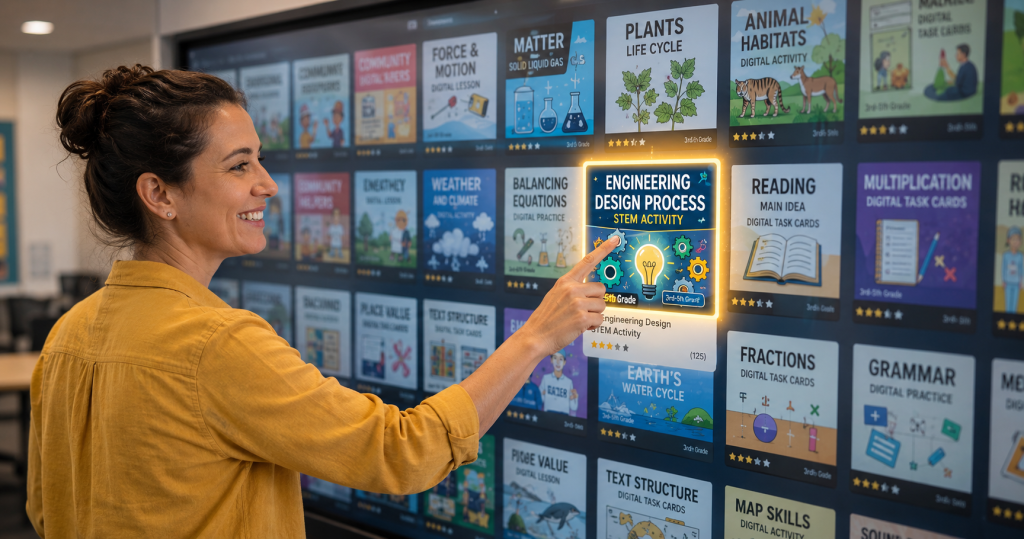
If you’re only going to use one platform, make it Teachers Pay Teachers (TPT). It’s the largest marketplace for teacher-created digital resources, and the sheer volume of content available — across every grade level, subject area, and standard — is unmatched.
Here’s something important that most teachers don’t know about how TPT works: it’s algorithm-driven. Resources rank based on a combination of SEO, frequency of sales, and click-through rates. The digital resources that show up on the first two or three pages of any search are the ones that have already proven themselves with other teachers. Most educators, pressed for time, never scroll past page three — and honestly, they probably don’t need to.
As a TPT creator myself, I work hard to rank on page one for my resources. And that competitive pressure generally benefits you as a buyer. The digital resources that rise to the top have usually earned their spot.
Other Platforms Worth Knowing
Boom Learning is a solid secondary option, particularly if you’re looking for digital task cards and self-grading activities. It works well across grade levels and has grown significantly in recent years — worth bookmarking if you rely heavily on interactive digital formats.
Made by Teachers is another marketplace, though in my experience, it hasn’t gained the same traction as TPT. You may find some useful digital resources there, but I wouldn’t make it your primary destination.
For most teachers, TPT is the right starting point, with Boom Learning as a useful backup for interactive digital work.
How to Evaluate Digital Resources Before You Buy
This is where a lot of teachers could sharpen their approach. Evaluating a digital resource is actually a layered process — like window shopping — and once you understand the layers, you’ll make far fewer purchases you regret.
Here’s how it works, from first impression to confident decision:
- The cover image. This is your first signal. A well-designed cover with readable fonts and clear images — ideally showing the actual product — tells you the creator cares about quality. A cluttered, hard-to-read cover is often a preview of what’s inside.
- The thumbnail images. Most listings include multiple thumbnails below the cover. These give you a quick look at layout, design, and content. Flip through them before reading a single word of the description.
- The preview file. This is the most underused tool in a teacher’s evaluation toolkit. Most quality TPT listings include a PDF preview showing actual pages of the product. If a listing doesn’t have one, that’s a yellow flag. If it does, open it.
- The description. By this point, you should already have a gut feeling about the resource. The description fills in the specifics — grade level, standards alignment, page count, format, and intended use.
Work through these layers in order. If the cover and thumbnails don’t impress you, no description is going to change that.
Pay Attention to Reviews and Store Ratings
Teacher feedback is one of the most valuable signals available when searching for digital resources, and it’s worth slowing down to read it.
On TPT, every resource can receive written reviews alongside a star rating. These come from real teachers who used the resource with real students. They’ll tell you things the product description never would — whether the activity ran long, whether students found it engaging, or whether it translated well across different grade levels.
Here’s an example from one of my own products, a science activity built around the engineering design process:
“This was a fun and engaging activity for my 4th-grade enrichment students. It was a great review of the engineering design process.” — Dalene N. (5 stars)
“Used start of year for Nature of Science. Later referenced activity during the weather unit. Great connection!” — Laura L. (4 stars)
Look at what those two reviews reveal together: the activity worked for enrichment students, it was effective at the start of the year, and it connected naturally to a completely different unit months later. That kind of real-world context is something no product description can manufacture.
Individual digital resources aren’t the only things rated — the stores themselves carry ratings too. My store sits at a 4.7 out of 5, and that’s a number I work to protect. When you find a store with a strong rating and a solid review count, you’re generally looking at a creator who takes quality seriously. You can also check how many times a resource has been liked or favorited — high engagement across a catalog is a reliable sign of consistent quality.
Search Smarter, Not Harder
A few habits that will save you real time when hunting for digital resources on TPT:
Use specific search terms. “7th-grade cell division activity” will serve you far better than “biology activities.” The more precise your query, the more relevant your results — and the more likely you are to surface something already aligned to your curriculum.
Filter before you scroll. TPT’s filters let you narrow results by grade level, resource type, price range, and file format. Set those filters before you start browsing, not after you’re already ten pages deep.
Check the “Related Resources” and “Also purchased” sections on any listing you like. This is often how you discover a creator’s broader catalog — and if one of their digital resources impresses you, the rest are worth exploring.
When you find a creator whose work consistently delivers, follow their store. You’ll get notified when they add new products or run sales, which means you stop hunting and start getting things sent to you.
The Relevancy Problem — and How to Fix It
The single biggest frustration teachers have with digital resources isn’t cost or quality — it’s relevancy. Finding something that looks polished but doesn’t connect to what you’re actually teaching is a waste of time and money.
The fix is to search with your standards in mind, not just your topic. If you’re working toward a specific NGSS performance expectation, a Common Core standard, or a state-specific benchmark, include it in your search terms. Creators who build with standards in mind almost always list them prominently — in the description, in the thumbnails, and often right in the title.
If you can’t find a digital resource that hits your exact standard, look for something close and ask whether it’s adaptable. A high-quality resource from a trusted creator is often worth a small modification on your end. A mediocre resource that’s perfectly aligned to your standard isn’t worth the download.
A Word on Cost
Free isn’t always better, and paid isn’t always worth it. The most useful way to think about cost is in terms of time: if a $5 digital resource saves you two hours of work and delivers a better result than what you’d produce under deadline pressure, that’s not a purchase — it’s an investment in your sanity.
That said, most platforms, including TPT, have a solid library of free resources, and many creators offer freebies specifically to let teachers experience their quality before spending money. If you’re trying a new creator or exploring a new subject area, always look for a free resource from them first.
Looking for Science Digital Resources? Start Here
If science is on your plate — whether that’s physical science, life science, earth science, general science, or engineering design — explore these digital science resources before digging into the broader catalog. They include both free and paid materials designed specifically for upper elementary and middle school science teachers.
Built specifically for science teachers at the elementary and middle school level, the store carries a 4.7-star rating earned through real classroom use. Every digital resource is designed with curriculum relevance and student engagement in mind, so you’re not taking a gamble on quality. It’s the kind of store worth following so you’re always in the loop when something new drops.
Finding great digital resources is a learnable skill. Once you know where to look, how to read a listing, and what signals actually matter, the process gets faster, and the results get dramatically better. Your time is too valuable to spend it sifting through things that don’t deliver.
Looking for ready-to-use lessons, labs, activities, and classroom materials? Browse our digital science resources for upper elementary and middle school teachers.