

Cats are one of the most popular pets in the world — with an estimated 600 million domestic cats worldwide, they’ve clearly won us over. And yet, despite sharing our homes with them, most of us know surprisingly little about the science behind what makes cats, well… cats. Here are the cat science facts.
In honor of your kitty and cats everywhere, we take a look at the household feline, Felis catus (also known as Felis domesticus), and offer some fascinating cat science facts.
August 8th is International Cat Day, October 16th is Global Cat Day, and October 29th is National Cat Day. Three separate days — which seems like a lot, but the general emphasis appears to be aimed at raising awareness and protection of cats everywhere.
Anatomical Cat Science Facts
Cats:
- have scent glands on their head, rear, and paws to mark their territories
- have 12 whiskers on either side of their face that are used to detect objects & air movements, navigate small spaces, and help with communication
- The eyes are well-adapted to low-light conditions
- can see in light levels 6x lower than humans
- have 3 eyelids (weird, huh?)
- have tufts of hair at the auditory canal that not only keep out dirt but also help funnel sound into the ear
- have no eyelashes (for most species)
- can rotate their ears 180 degrees
- normal body temperature ranges from ~100-102 degrees F
- A normal heart rate runs around 110-140 beats per minute
- can only retract their front claws
- front paws have 5 toes, back paws 4
- Spines have 53 vertebrae compared to humans, with 34
- Kidneys can filter salt out of seawater
- purr at frequencies between 25-150 Hz
- noses have a unique pattern for each animal…like a fingerprint for humans
- sweat through their paws
- have no collarbones
- Females tend to be right-pawed, males left-pawed
- Jaws don’t move sideways
Other Cat Science Facts:
- don’t have a taste for sweets
- can detect earthquake tremors 10 or more minutes before humans
- make 10x more sounds than dogs
- can jump up to 5x their height in 1 bound
- Purring is an indication that they are happy, threatened, or frightened
- Like dogs, they rely on smell to identify people & objects
- can hear sounds octaves higher than humans
- average life span ~12-18 yrs
- foods not to feed your cat: onions, garlic, green tomatoes, raw potatoes, chocolate, grapes, raisins
The Science Behind the Cat Facts
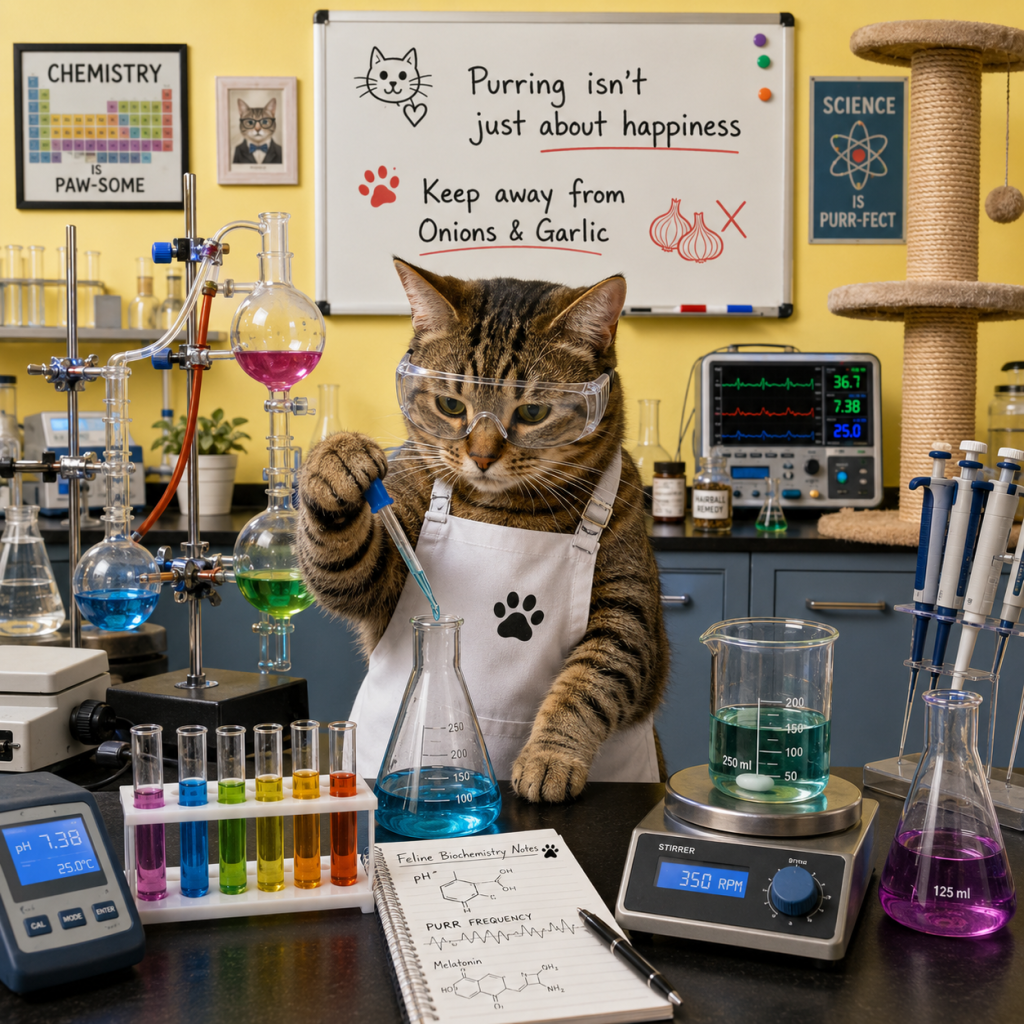
Purring isn’t just about happiness. Cats purr at frequencies between 25 and 150 Hz, and researchers have found that these frequencies promote bone density and healing in soft tissue. This may explain why cats seem to recover from injuries faster than you might expect — and why curling up with a purring cat might actually be good for you too.
The jaw structure is by design. Unlike humans and many other animals, a cat’s jaw can only move up and down, not side to side. This is because cats are obligate carnivores — meaning they must eat meat to survive. Their jaws are built for gripping and tearing prey, not grinding plant material. Everything about a cat’s anatomy points back to its role as a predator.
Those whiskers are doing a lot of work. Cats have 12 whiskers on each side of their face, and they’re deeply rooted in tissue rich with nerve endings. They don’t just detect objects — they can sense changes in air currents, which helps cats navigate in the dark and even judge whether they can fit through a tight space.
Onions and garlic are genuinely dangerous. The “foods to avoid” list isn’t just cautionary — some of those items are toxic to cats at the cellular level. Onions and garlic, for example, contain compounds that break down a cat’s red blood cells, which can lead to a form of anemia. Even small amounts over time can cause serious harm, so it’s worth keeping these well out of reach.
Conclusion
Whether you are a fan of cats or not, you have to admit that cats are quite amazing. From self-healing purrs to earthquake detection, the science behind our feline friends is genuinely surprising. And to have 3 separate times of the year set aside to honor them? That feels about right.
Got a cat of your own? Drop a comment and tell us something surprising about your kitty — we’d love to hear it.
Here’s to all you cat lovers!
For other interesting science facts, check out the science of chocolate and glass.