In the last post, I outlined the pros and cons of three grading practices:
A-F, Standards-Based, and Excellent-Satisfactory-Needs Improvement.
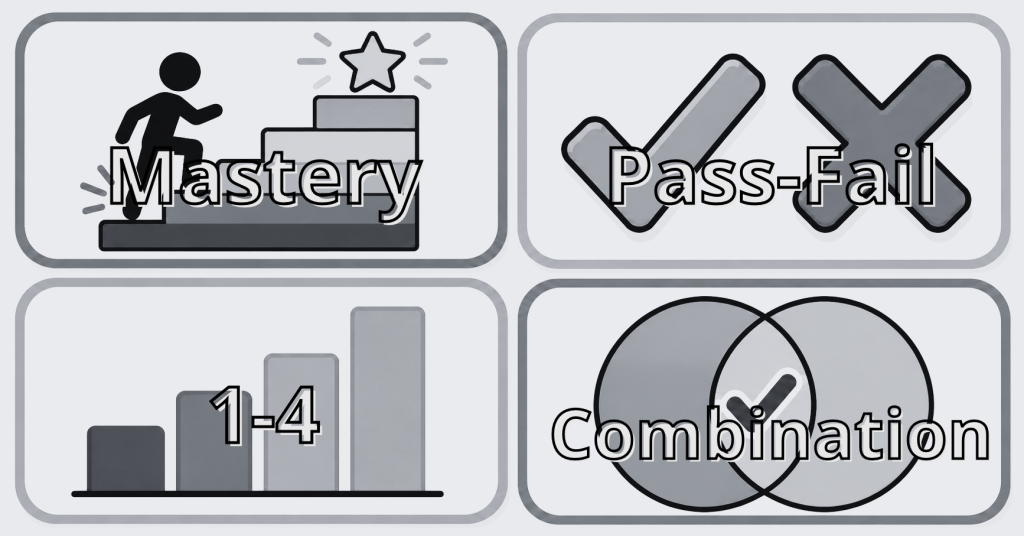
This post will finish up by covering the pros and cons of mastery grading, pass-fail, 1-4, and combination systems:
Mastery Grading, Pass-Fail, 1-4, and Combination Systems
The usual practice is to have students stick with a topic, concept, or objective until it is mastered. Mastery means that the student has met the teacher’s criteria. Note that mastery does not have to be 100%. The teacher chooses the cut-off point. For a closer look at how this works in practice, the University of Nebraska-Lincoln has a helpful overview of mastery grading.
Mastery grading is an excellent way to target a broad range of student abilities.
Pros
- The one main advantage of mastery grading is that it allows students of all abilities to succeed
Cons
- Paced curricula can leave those who struggle at a disadvantage
- Teachers need to keep track of students with varying levels of completion
- Quarterly, semester, or other final grading points can prove troublesome
Pass-Fail
This is a straightforward grading practice system. Whether used for individual assignments or end-term grading, the teacher determines if a student has passed or failed.
Pros
- Simple to implement the two-part system
- Works well for classes that have subjective material to grade
- Works well for lower-level elementary students
Cons
- Doesn’t work well for core curricula
- Doesn’t work well for standards-based practices
- Ambiguous for setting criteria to determine pass-fail
1-4
This is a numerical version of the A-F system. 4 represents the highest level of achievement, and 1 is the lowest level.
Pros
- Easy to implement
- Has a familiarity to it (like the A-F)
- Used in some college-level classes.
Cons
- You can “split hairs” administering grades
- What represents failure (1?, <1?)
- Do you assign grades below 1? (.1-.9)
- Not appropriate for elementary-level
- Not a good fit for middle school
Combinations
Teachers may choose to use one system for some assignments to make grading easier. An example would be using pass-fail for homework. Pass means you did it. Fail means you didn’t. For assessments or weightier work, they may use another system. For instance, for everything else, they may apply the A-F, 1-4, Mastery, or another system.
Pros
- Lesser and greater assignments can be assigned a grade
- Allows for flexibility in grading
Cons
- Can be confusing for teachers and students
- Creates more work for the teacher
Naturally, each system has positive points. Hey, it wouldn’t be used if it didn’t! But each system has drawbacks.
You may be in a school or district that has the system laid out. Your only recourse is in how you assess the work.
Or, you could be in a school or district that gives you flexibility in how you approach grading.
In either case, you have what you have.
Truthfully, I’m not sure there is a perfect system.
Whether you choose mastery grading or another system, you have what you have.
What do you think? Which system do you use? Let me know in the comments.
Whichever system you land on, the pile of papers is still waiting. In the next post, I’ll share grading tips for teachers to help you cut down on grading time.