In 33 years of teaching science in a variety of settings, I saw the blank stare in every kind of classroom. Every classroom has students who have decided science isn’t for them. If you’re wondering how to make science engaging for those students, I have good news and honest news. Some of them can be reached, some can’t, and the difference often comes down to how you teach and what the student is willing to bring to the table.
The Density Lesson That Taught Me a Lesson
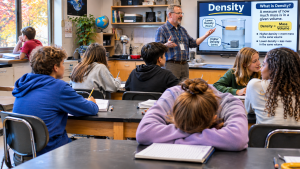
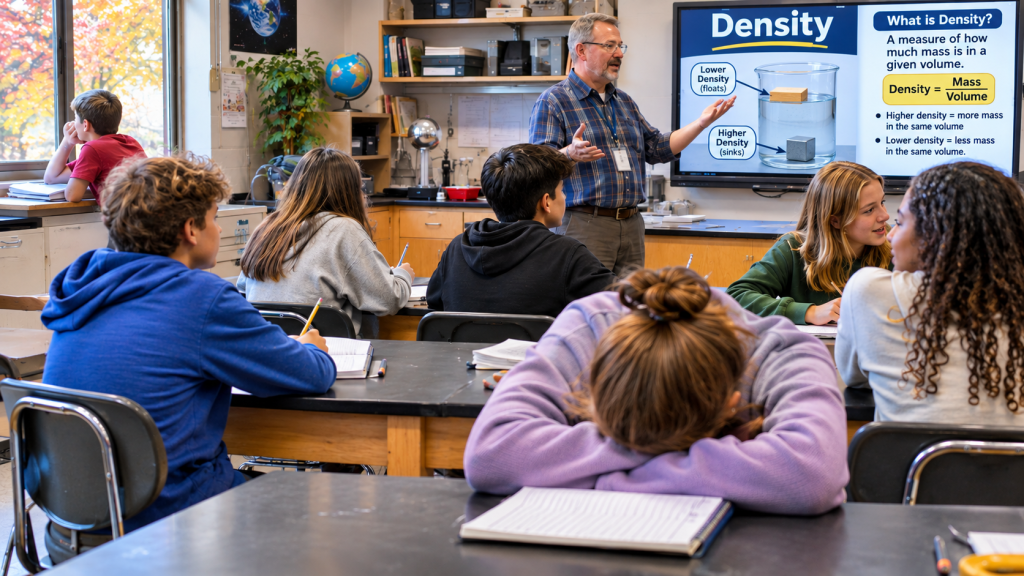
There was a time I taught density the way I’d been taught: straight to the topic. Here’s what you need to know, here’s the formula, any questions? I relied on lectures, notes, and drawings on the board.
Very few students grasped it. Some drifted into “I don’t care” mode. Others gave me the deer-in-the-headlights look, the “Huh?” and “What?” every teacher knows. Density is abstract and math-heavy, and I was handing it over in the most abstract way possible.
That was the moment I realized lecture, notes, and illustrations weren’t cutting it. If I wanted to make science engaging, I needed a completely different approach.
How to Make Science Engaging in Four Steps
Here is the approach I built for teaching density to middle school students. It works for plenty of other topics too.
Step One: Make It Relatable
I started with something every student already knew: do you tend to float or sink in a swimming pool? Suddenly density wasn’t a vocabulary word. It was something they had felt.
From there we talked about how submarines, fish, and scuba divers control buoyancy through density, and how hot air balloons work. I also used a wave in a bottle, and for some reason students loved it.
This helped them conceptualize density, but it didn’t get the math or the main ideas across. Relatability gets their attention. It doesn’t finish the job.
If you’d like a ready-made starting point, this density slide presentation and lab activity walks students from concept to lab.
Step Two: Hands-On Science Activities
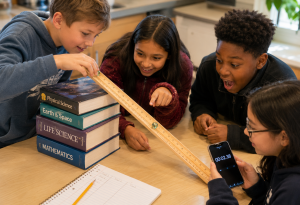
Adding density labs made a tremendous difference. Students were moving, working collaboratively, measuring, and testing. It was hands-on gold, and it’s the heart of making science engaging for students who would otherwise tune out.
Two activities stood out:
- The displacement method. Students were used to finding the volume of rectangular solids in math class, but they really loved finding the volume of irregular solids by displacement.
- Density columns. Floating different liquids on top of each other let them see density differences instead of just reading about them.
My density lab on calculating and comparing liquids and solids puts both of these into one hands-on activity.
With the labs in place, the math wasn’t the barrier I expected. Students who engaged could find or calculate volume, measure mass, and use the equation to solve for density.
Step Three: Help Them Understand the Data
Calculating a number isn’t the same as understanding it. Some students quickly saw that the larger the density number, the denser the substance. Others needed to take a step back before the significance finally sank in. The light bulb came on at different times for different students, and that’s okay.
Step Four: Make Them Use It
The final step was application. We started simple with finding the density of a regular solid, then an irregular solid. Then came the more thought-provoking problems:
- Calculate the density of two objects. If they were placed in a column of water, oil, or another liquid, where would each come to rest?
- Given a list of densities, rank the substances from least to most dense.
- Given a list of known densities, determine where an unknown substance would fall in the lineup.
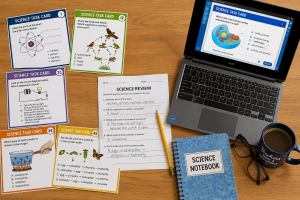
For extra practice that doesn’t feel like a worksheet, students enjoy this density, mass, and volume color-by-number.
This is where density stopped being a formula and became a tool. Students were using numbers to make predictions.
Why Science Students Who Don’t Care Check Out
Not everyone clicked, and I won’t pretend otherwise. Some students just didn’t want to learn. In my experience, science students who don’t care usually fall into one of four groups:
- They lost interest in science in an earlier grade.
- They didn’t see the need for it in their lives.
- A parent influenced them (“My dad was never good at science” or “My mom wasn’t either”).
- They were adolescents who needed to be seen and accepted by peers and were distracted by shiny objects.
Engaging Unmotivated Students in Science: What I Could Reach
Not every reason is equally stubborn, and knowing which one you’re facing helps you decide where to spend your energy.
Parent Influence and Peer Distraction
Parent influence was one of the easiest to steer in a better direction. Often, just showing students that my class was different, that science could be relatable and enjoyable, was enough to loosen the hold of “science isn’t for people like us.”
Peer distraction was sometimes easy to turn around too. Get their peers interested, and they often become interested. Or pair a distracted student with someone who is tuned in.
Lost Interest From an Earlier Grade
This one can be turned around, but it takes a lot of time, sometimes the entire time the student is in your class.
“Where Am I Ever Going to Use This?”
The hardest to reach was often the student who didn’t see the need for science. That question is tough, and it’s exactly why relatability matters so much. Pools, submarines, scuba divers, and hot air balloons weren’t just fun hooks. They were my answer to that question. (Sports can do the same job for physics topics, which I cover in these strategies for teaching science.)
The Student I Didn’t Fully Reach
I’ll call her Samantha. On day one, she gave me eye rolls, the occasional “I’m bored,” and a lot of head-down or asleep time. With prodding and encouragement, she slowly began to see that she was capable of doing whatever she set her mind to.
But she had success days and “I don’t care” days. Some days she worked with her group, and some days she didn’t. The toughest part was getting her to see that she was the one holding herself back. She had the ability and the intelligence.
She passed, barely. She could have been a B or C student. I won’t say an A, because she didn’t have the inner motivation to make that happen. I can’t say I failed to show her what she was capable of, but it wasn’t a glowing success either.
I share Samantha because I think we need more honest stories in education. Not every student has a movie-style turnaround, and that doesn’t mean you didn’t matter.
Making Science Engaging Still Comes Down to Student Choice
I kept a saying posted on my wall and pointed to it often: “It all comes down to the choices YOU make!”
Students who don’t care are a tough nut to crack. For many of them, society, family, friends, and peers have taught them not to care. So they invent excuses and have quick comebacks, which are really just more excuses for their defense.
In most cases, I don’t fault the teacher. The teachers, assistants, counselors, and specialists I’ve had the privilege of working with are caring, giving, empathetic, and creative people. Some students just don’t want to learn in our system of education, and that’s not always a reflection of the person standing at the front of the room.
That doesn’t mean we stop trying. It means we do our best, keep the door open, and stop carrying the full weight of every student’s choices.
If You’re Feeling Hopeless
If you’re a teacher who has reached the point of hopelessness, I want you to hear this: you are more valuable and gifted than you realize.
When a year of push-back classes wore me down, here’s what I did:
- I took it one day at a time and looked for the new light that could shine on that day, because of something I was doing or not doing.
- I thought about an upcoming topic, activity, or lab that might just make the difference.
- I kept myself hopeful on purpose.
It also didn’t hurt that my course ran by semester rather than the full year, so the end was never that far off. If you don’t have that built-in reset, create your own. Break the year into smaller pieces and give yourself a fresh start whenever you can.
Final Thoughts on How to Make Science Engaging
Making science engaging isn’t about finding a magic trick. It’s about making the content relatable, getting students’ hands moving, helping them understand what the data means, and then letting them use it. Some students will light up. Some will light up slowly. A few won’t light up this year, and that’s part of the job too.
Keep showing up, keep making science real, and keep looking for the next lab, activity, or topic that might make the difference.